Some questions don't fit in one search. "How will generative AI change marketing by 2030" looks like a query, but it's really three or four questions wearing a trench coat: one about capabilities, one about industry structure, one about timing, each needing its own evidence. Ask a system to answer it in a single pass and you get one of two failure modes. Either a flattening — generic paragraphs that could have been written without looking anything up — or a confabulation, specifics invented to fill the gaps the single retrieval couldn't cover.
The standard framing of the second failure is that the model doesn't know enough: a knowledge problem, to be fixed with bigger models and better data. Building an answer engine gave me a different read. The models hallucinated most on exactly the questions a thoughtful person wouldn't try to answer in one breath, and that points at process. A researcher facing a hard question doesn't produce an answer from memory; they produce an investigation. Decompose the question, gather evidence per sub-question, synthesize with citations. The reliability lives in the method.
So the project became teaching the search engine the method.
The shape of the system
Research mode runs a query through four stages, mirroring the human procedure:
- Intent analysis — figure out what kind of question this is and how it wants to be decomposed
- Decomposition — break it into smaller research questions that are individually answerable
- Per-question retrieval — search the index separately for each one, so every sub-question gets its own evidence
- Synthesis — compile a structured report, cited throughout
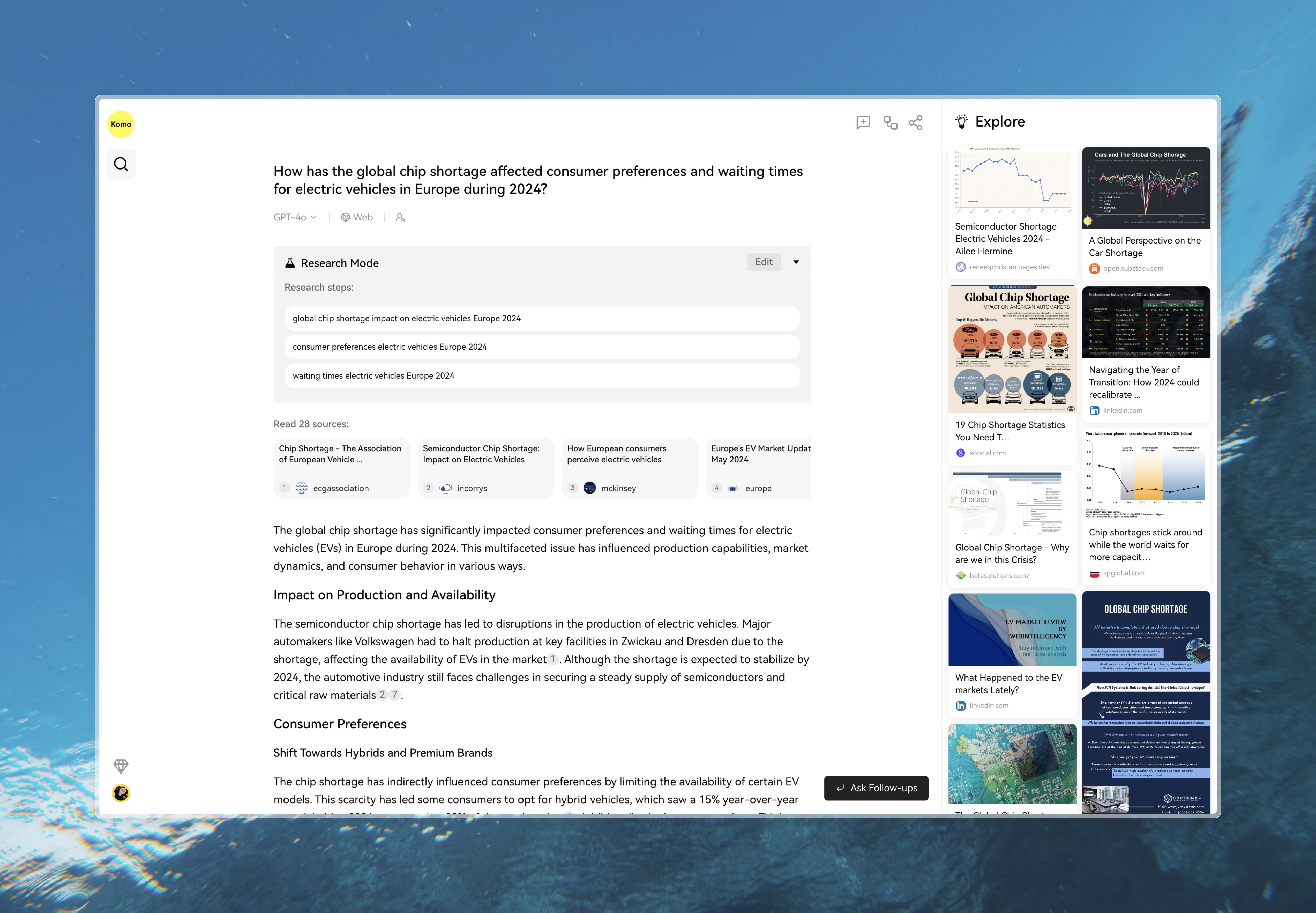
Decomposition helps for a mechanical reason. A single retrieval pass has to serve every information need in the question at once, so the evidence comes back thin and scattered, and the model fills the gaps from its priors — which is what confabulation is. Give each sub-question its own retrieval budget and the evidence comes back dense. By the time synthesis runs, the task is closer to constrained summarization than to open-ended generation, and the report has something specific to stand on.
There was a cost, and I decided to spend it openly: research mode is slower than a regular search, sometimes by half a minute. The prevailing instinct in search is that latency is death, but that instinct was calibrated on lookup queries, and this is a different contract. People wait for depth when the depth is real and the system is visibly working; the interface shows the plan and each sub-question being answered, so the wait reads as work rather than silence. That held. Nobody complained about the wait. They complained when a fast answer was shallow.
What people used it for
The queries were the ones search engines historically punted on, where "here are ten links, good luck" was the honest response:
- "The most effective intermittent fasting methods for metabolic health, per recent studies"
- "Applications and ethics of CRISPR in genetic disorders, based on recent clinical trials"
- "How generative AI will impact the marketing industry by 2030"
- "Implications of the EU Digital Services Act for content moderation"
What I learned
Decomposition measurably reduced hallucination on complex queries. Same models, same index; the difference was entirely in the process. This convinced me that a meaningful share of what we call hallucination is a workflow deficiency. We ask models to skip steps no careful thinker would skip, then act surprised by the confabulation.
The subtler lesson was about legibility. People trusted the reports partly because they could see the structure of the investigation: which sub-questions were asked, which sources fed which section. A report whose derivation is visible is a different object than an oracle's pronouncement, even at identical accuracy. That observation kept compounding, and I later made the research plan itself editable, so you can inspect the intended steps, revise them, and re-run. The system proposes the method; the person supervises it.
Where it led
The decompose–retrieve–verify–synthesize loop turned out to be the most durable thing I've built. It began as a way to answer hard questions and became the machinery underneath autonomous operations that act on the answers. So, can AI conduct research? Yes, when you give it the method. What I'm still working out is how far the method generalizes, and how a person stays meaningfully in charge of an investigation they didn't personally run.