A pattern in how people used Komo kept catching my attention: many sessions were orientations, not lookups. Someone preparing to enter a new industry, or handed a big unfamiliar project, or writing a report due Friday, would ask a dozen questions in a row, circling a territory rather than retrieving a fact. Search engines are built for the fact case and serve the orientation case badly. You end a long session with twenty answers and no shape.
The distinction has a long history in how researchers think about information seeking — lookup versus exploratory search, foraging for pieces versus assembling them into sense. What I noticed is that the assembly step, the actual sensemaking, happened entirely in people's heads or not at all. The tool helped you gather, then abandoned you at precisely the moment understanding was supposed to occur.
Structure is the understanding
Repeatedly entering new fields (engineer to product, search to founder, every domain a startup drags you through) taught me that the hard part of learning is forming the framework the facts hang on. When you know a field, what you possess is its shape: the major regions, how they connect, what's central, what's peripheral. Facts without that shape evaporate. Memory palaces and good outlines run on the same trick — build the structure first, and the details become easy to place and recall. Strong learners make this move instinctively. Most people were never shown it.
So the design question became: could the system perform the structuring move for you, at the moment you need it?
The map should come from your path
The critical design decision was where the structure comes from. The obvious version of this feature generates a canonical taxonomy of the topic, the Wikipedia-outline view of, say, quantum computing. I built prototypes of that and found the results strangely inert. A canonical map answers "how is this field organized?" but not "how does this field connect to what I was trying to figure out?"
The version that worked generates the map from the person's own exploration. At the end of a thread of queries, one click: Komo summarizes the whole conversation, extracts the branches and their relationships, and draws the diagram of your traversal rather than the field's official anatomy. The branches are the questions you actually asked, the labels are in your own vocabulary, and the structure mirrors the mental model you were already half-building. It's the difference between being handed someone else's outline and having your own notes organized for you. Only one of those sticks.
Deriving the map from the thread also makes it reliable to generate. The conversation is the corpus. The model isn't asked to invent the shape of a discipline from its weights; it's asked to surface the shape already latent in a specific exploration. That's closer to summarization than to authorship, and it grounds the diagram the way citations ground an answer.
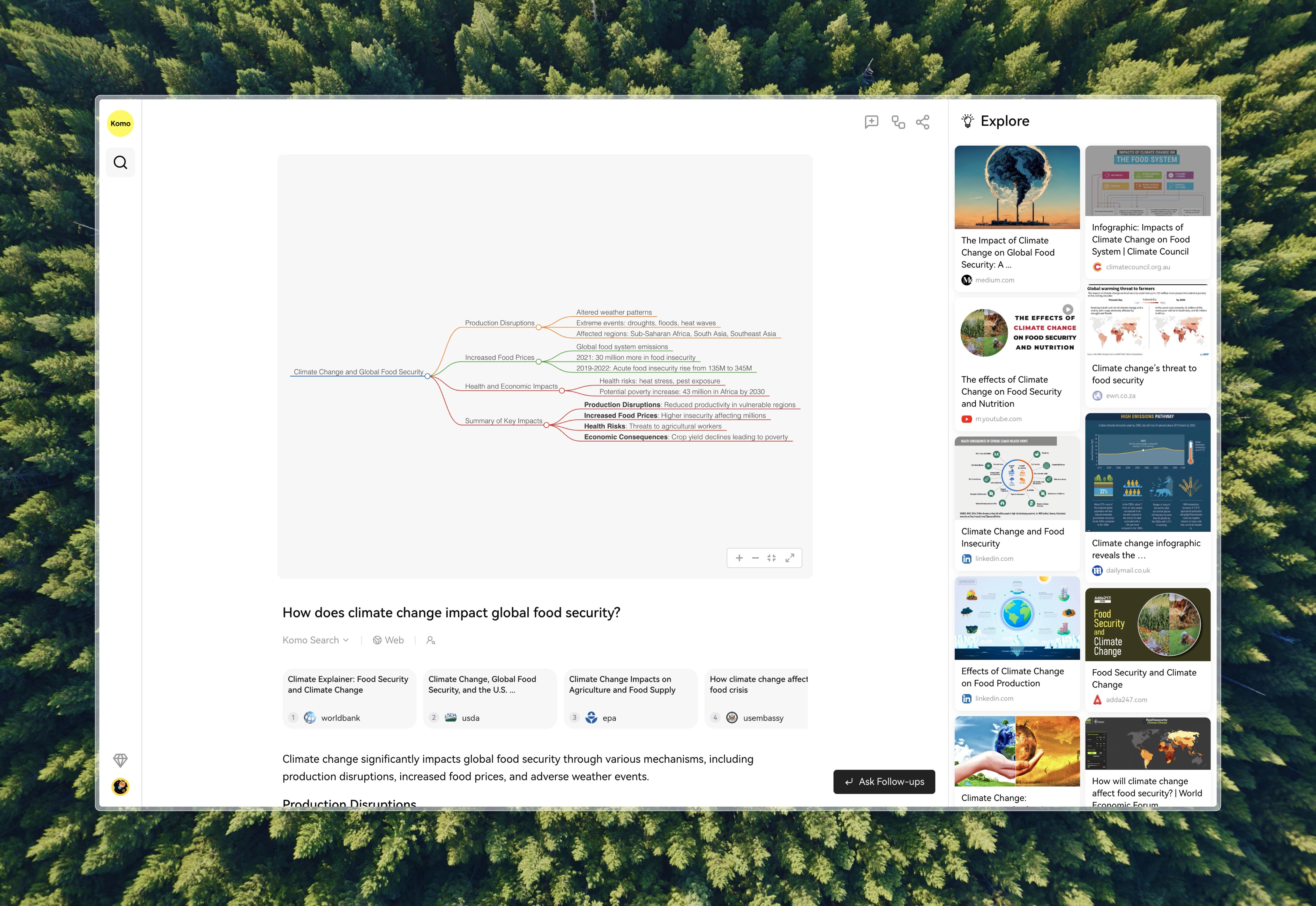
A few real threads, with their maps: "What are the key components of a successful startup ecosystem?", "How does climate change impact global food security?", "What are the main schools of thought in modern psychology?".
What I observed
Two things surprised me after shipping it. First, people treated the maps as artifacts. They saved them, pasted them into planning docs and presentations, used them as the skeleton for writing. The map outlived the search session, which almost nothing in a search product does. Second, the feature changed how some people searched: knowing a map was coming, they explored more systematically, almost interviewing the topic. The representation shaped the behavior upstream of it, a small and satisfying case of the tool teaching the method.
The cases it serves best are the orientation cases that started the project: brainstorming, project planning, getting your arms around a complex topic, organizing research before writing.
Open questions
The maps are snapshots: one thread, one diagram. The version I keep imagining is cumulative — a map that grows across sessions as your understanding of a field deepens, something between a knowledge graph and a learning journal. There's a social question too: is one person's curiosity-map useful to the next learner, or is the value precisely that it's yours? My instinct says the path matters more than the map. I'd love to be wrong. A library of a million learning paths would be a remarkable thing to study.