I've spent most of my career inside search engines, first at Google, then building my own, and the uncomfortable fact at the center of the field is that ranking is mostly popularity. Clicks, links, engagement. Whatever sophistication we layer on top, the system is surfacing what many people responded to, and users read that positioning as truth. The first result feels authoritative because it's first. Search engines encourage the conflation, because trust drives engagement.
Most of the time the gap between popular and true is harmless. Sometimes it isn't. In 2016, a college student died after trusting a promoted search result about cancer treatment — a result that ranked well, looked credible, and was fatally wrong. I think about that case a lot, because nothing in the standard search-quality toolkit would have caught it. The failure was authority granted by position, and relevance metrics can't see that.
Then AI answers arrived and sharpened the problem. A language model can cite sources and still hallucinate, while sounding more confident than any web page ever did. We built machines that speak in the register of authority whether or not they've earned it.
The reframe
The question I kept circling: what if authority isn't a property a system can claim at all? A person you trust isn't someone who's always right. It's someone whose reasoning you can inspect, who shows you where their beliefs come from, who tells you when the evidence is mixed. Authority, in that sense, is earned through verifiability.
That reframe turns the design problem inside out. Instead of making the answer sound more right, make it easier to check. I rebuilt Komo's answer experience around three principles that follow from it.
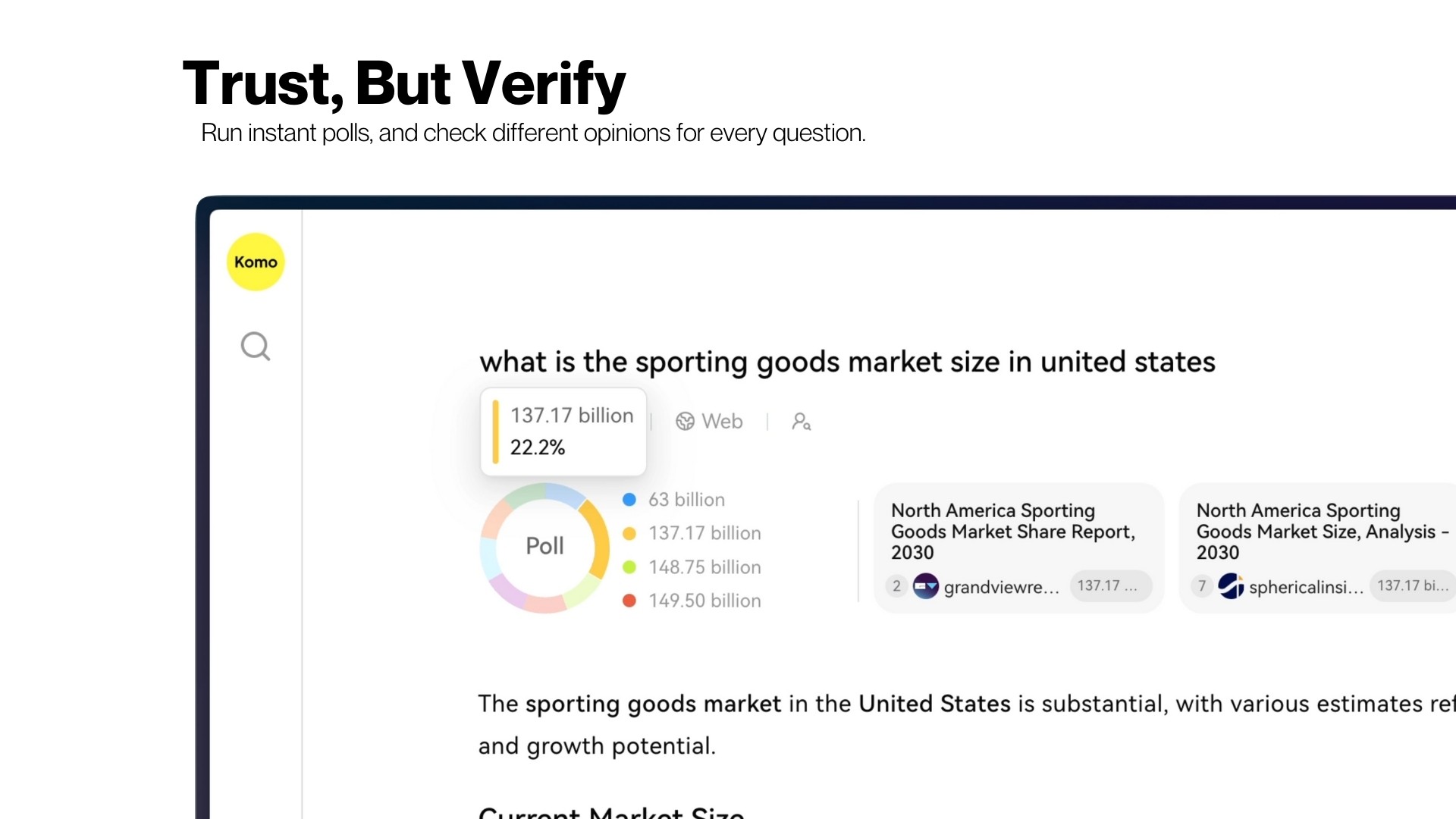
Show the distribution, not the verdict. For questions where sources genuinely disagree, a single synthesized answer is a quiet lie: it collapses a distribution into a point. So Komo aggregates the positions sources take and shows them as a poll — how much consensus exists, where opinions diverge, which sources hold which view. The honest shape of the evidence, visible before any conclusion.
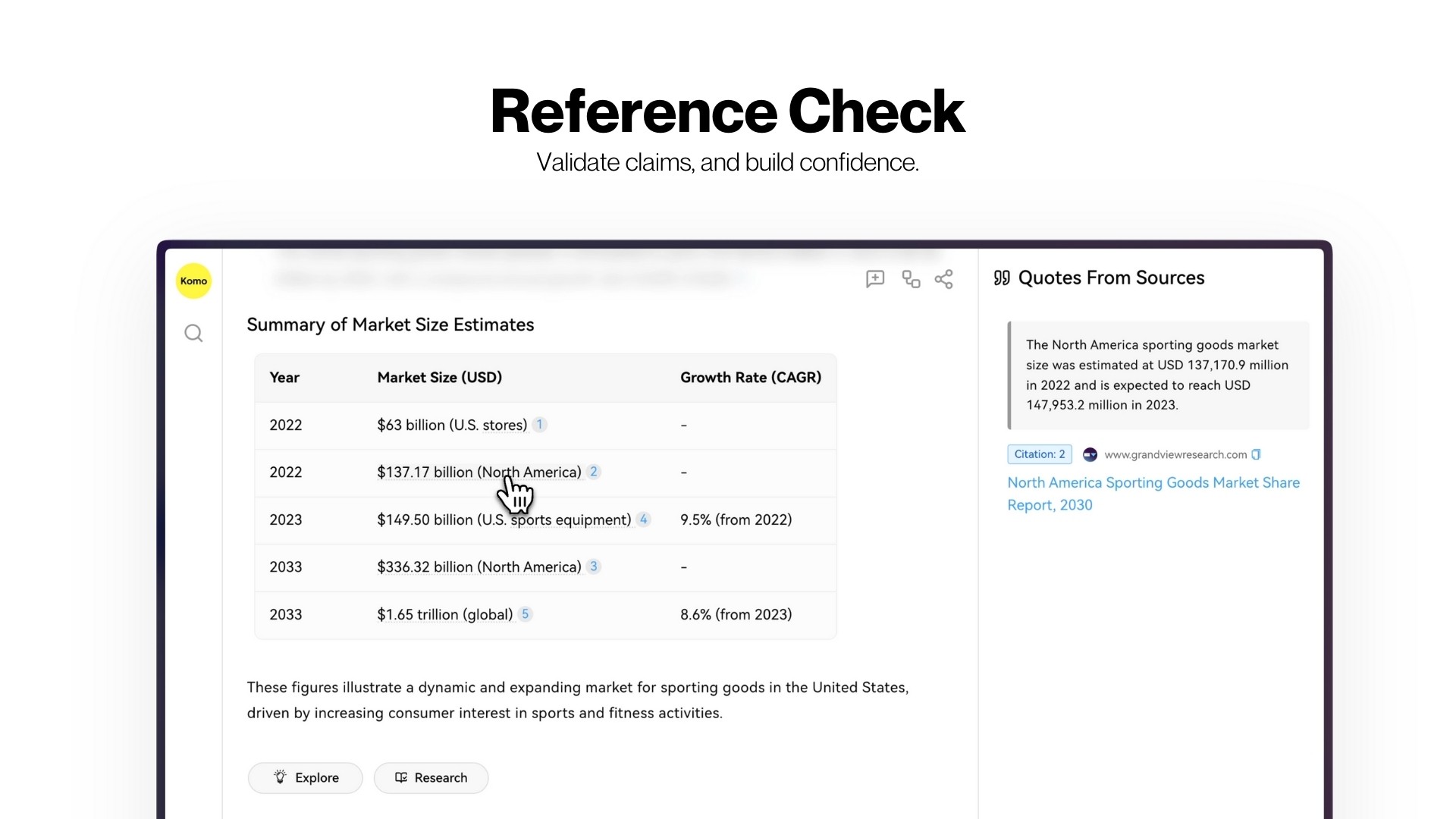
Shorten the verification loop to zero. People tell us they want to check AI claims, and then they don't, because checking means opening every citation in a new tab, and the whole point of an AI answer was to avoid that. Verification has to be cheaper than doubt. Reference check shows, for each claim, the exact passage in the source that supports it: hover a citation and the quote appears in place; click through and you land on the quoted section of the page.
Expose the reasoning process. For complex questions, Komo's research mode already decomposed the question into steps before answering. I made the plan itself visible and editable, so you can see how the system intends to investigate, change the steps, and re-run. An answer whose derivation you can inspect is a different epistemic object than an answer that simply appears.
A design detail I care about: these features trigger themselves only when they're useful. Polls appear when sources actually disagree; reference check appears on claims worth checking, not on navigational queries. The triggering is its own systems problem, since the engine has to detect disagreement and claim-worthiness before it can be honest about them, and it's load-bearing. Trust tooling that shows up indiscriminately becomes noise, and noise trains people to ignore it.
What I learned
Trust went up when we stopped asking for it. Showing disagreement made people trust the system more, not less; the honesty about uncertainty read as competence. And the decomposed research process measurably reduced hallucinations on complex queries, which suggests the transparency isn't epistemics theater. Making a system show its work also disciplines the work.
Under the hood this runs on a mix of models, routed per query: fine-tuned open-source models where control and unit economics matter, closed models where frontier reasoning matters, with a proprietary layer for query understanding, reranking, and page understanding. But the stack matters less to me than the stance. The system does the legwork, and the person keeps control over how information is found and verified.
Open questions
Where does this stop? Every verification affordance adds friction somewhere, and there's a real tension between the reader who wants to check and the reader who wants to move on. I also wonder what happens to the web's incentive structure if answer engines start rewarding verifiability rather than popularity — whether pages will be written to be checkable the way they're currently written to rank. That would be a better web. I'd like to help cause it.